

At UCD Greenacre, sustainability is not just a buzzword… it’s a living, breathing practice.
The campus sustainability hub accomplishes something remarkable: a fully circular mushroom farm that uses coffee waste to create food and closes the loop completely. This achievement demonstrates how educational institutions can lead by example, transforming waste into valuable resources while teaching the next generation about sustainable practices.
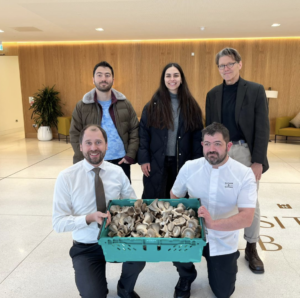
The first batch of mushrooms grown at Greenacre using coffee grounds from UCD Club Cafe are delivered back to the cafe. Source: UCD Sustainability Instagram
What is Circular Economy?
The circular economy represents a fundamental shift from our traditional “take-make-dispose” linear economy model. Instead of extracting resources, using them once, and discarding them as waste, a circular economy keeps materials and products in use for as long as possible through reuse, repair, refurbishment, and recycling.
Think of it as nature’s model: in healthy ecosystems, there’s no such thing as waste. One organism’s output becomes another’s input, creating closed loops where nutrients continuously circulate. The circular economy applies this principle to human systems, designing out waste and pollution while regenerating natural systems.
UCD Greenacre’s Mushroom Farm: A Perfect Example of Circular Economy
The mushroom farm at UCD Greenacre exemplifies circular economy principles in action. Located at the heart of the campus, this innovative project demonstrates how agricultural waste can be transformed into nutritious food while eliminating waste at every stage.
The circular process works like this: the farm uses coffee grounds collected from UCD University Club as the primary growing medium for oyster mushrooms. Instead of these grounds ending up in landfill, they’re given new life as nutrient-rich substrate for mushroom cultivation.
But the circularity doesn’t stop there. Through a collaboration between UCD School of Biosystems and Food Engineering, UCD University Club, and UCD Innovation Academy, the mushrooms grown using the Club’s coffee grounds are delivered back to UCD University Club.
“This was a team effort,” said Dr. Thomas Macagno, Education Innovation Lead (Sustainability) at Innovation Academy.
“Student interns and volunteers spent the weeks cleaning the farm and buckets. They were also making the buckets, setting up and monitoring tech and handbooks, emptied spent buckets in a compost system we built, collecting coffee, harvesting and delivering the mushrooms. There’s also Ilie Motofelea, the General Manager UCD University Club and his team, who have supported incorporating mushrooms into the club menu. And then Dr. Dimitrios Argyropoulos of the UCD School of Biosystems and Food Engineering and his team of mushroom experts have been critical to supporting these efforts.”
This closed-loop system delivers multiple benefits:
- Waste reduction: Coffee grounds from UCD University Club become valuable growing resources
- Complete circularity: Mushrooms return to their source, closing the loop from waste to food
- Local food production: Fresh, organic mushrooms grown and consumed in campus
- Collaborative innovation: Partnership between engineering, hospitality, and other units in the university
- Carbon footprint reduction: Minimal transportation in a truly local food system
- Educational leadership: Demonstrating circular economy at a scale few universities worldwide have achieved
“We closed the circle in Circularity,” Thomas added. “So many people and activities came together for this to happen. Well done, everyone!”
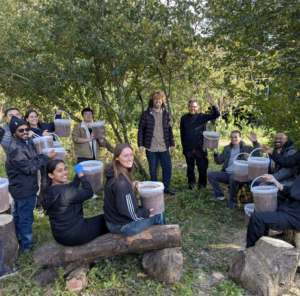
The community comes together at Greenacre. Source: UCD Sustainability Instagram
Learning Circular Economy at UCD Greenacre
Understanding circular economy principles is one thing; experiencing them firsthand is another. That’s where UCD Innovation Academy’s Design a Sustainable Future module comes in.
This undergraduate module, which primarily takes place at UCD Greenacre, immerses students in circular economy concepts and sustainable design thinking. Students engage with it directly at the Greenacre hub, where projects like the mushroom farm bring theory to life.
The module covers sustainable innovation, circular design principles, and systems thinking, equipping students with the knowledge and skills to create solutions for real-world environmental challenges. By learning in the same space where circular economy is actively practiced, students can see, touch, and understand how abstract sustainability concepts translate into concrete action.
This experiential learning approach helps students develop the critical thinking and problem-solving abilities needed to drive sustainability forward in their future careers, regardless of their field of study.
Join the Circular Economy Movement
The success of UCD Greenacre’s mushroom farm demonstrates that circular economy isn’t just theoretical—it’s practical, achievable, and scalable. From coffee grounds at UCD University Club to mushrooms at Greenacre and back to the Club’s tables, this closed-loop system shows how innovative thinking can transform waste into opportunity while creating genuine circularity.
Whether you’re interested in learning more about UCD Greenacre, exploring Innovation Academy programmes, or discussing potential partnerships to advance circular economy initiatives, we’d love to hear from you.
Get in touch: For any questions about UCD Greenacre, our sustainability-focused modules, or partnership opportunities, please email us at innovation.academy@ucd.ie